



Infectious Diseases
Infectious Diseases Index
Chickenpox/Varicella
Chickenpox (varicella) is a contagious disease caused by the varicella-zoster virus. It is typically characterized by an itchy rash, fever, tiredness, loss of appetite, and headache. It is spread from person to person by someone who has a chickenpox infection, you can also get chickenpox from someone who has shingles. While often considered mild in children, it can be more serious for adults, pregnant people, and those with weakened immune systems, chickenpox can lead to severe complications such as skin infections, pneumonia, encephalitis, bloodstream infections, and, in rare cases, death.The varicella vaccine is highly effective, preventing approximately 90% of cases and significantly reducing severity in breakthrough infections. By avoiding a chickenpox infection you are also protected against developing shingles later in life. Since the introduction of the chickenpox vaccination program in the United States, cases have decreased by more than 97%, and hospitalizations and deaths have become rare. Individuals who have never had chickenpox and have not been vaccinated should receive two doses of the vaccine. Those who have received one dose of the vaccine should check in with their primary care provider. Post-exposure vaccination can prevent disease or reduce severity and offers protection against future exposures. Macalester recommends the chickenpox vaccine, its available through your primary care provider and at pharmacies near campus, such as CVS and Walgreens. Need help finding a pharmacy need you check out vaccines.gov. While this vaccine is not available at the Hamre Center, Hamre Center Medical Staff are happy to talk with you about the vaccine and answer any questions you have.
COVID-19
The Hamre Center is offering guidance to students and those supporting students, though much of the best practice is the same for everyone.
When you may have a respiratory virus…
Stay home and away from others (including people you live with who are not sick) if you have respiratory virus symptoms that aren’t better explained by another cause. These symptoms can include fever, chills, fatigue, cough, runny nose, and headache, among others.
You can go back to your normal activities when, for at least 24 hours, both are true:
- Your symptoms are getting better overall, and
- You have not had a fever (and are not using fever-reducing medication).
When you go back to your normal activities, take added precaution over the next 5 days, such as taking additional steps for cleaner air, hygiene, masks, physical distancing, and/or testing when you will be around other people indoors.
- Keep in mind that you may still be able to spread the virus that made you sick, even if you are feeling better. You are likely to be less contagious at this time, depending on factors like how long you were sick or how sick you were.
- If you develop a fever or you start to feel worse after you have gone back to normal activities, stay home and away from others again until, for at least 24 hours, both are true: your symptoms are improving overall, and you have not had a fever (and are not using fever-reducing medication). Then take added precaution for the next 5 days.
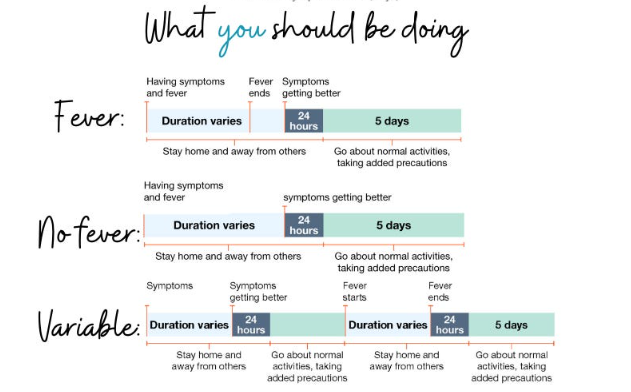
Graphic: Dr. Katelyn Jetelina, Your Local Epidemiologist March 2024
When you have a respiratory virus infection, you can spread it to others. How long someone can spread the virus depends on different factors, including how sick they are (severity) and how long their illness lasts (duration). This is not the same for everyone.
Students can contact the Hamre Center at 651-696-6275 or stopping by in person during business hours to make an appointment.
Call the Access Nurse line (651-696-6275, option 3)* for 24/7 medical advice. If you are experiencing severe symptoms and want to be seen urgently, see this list of urgent and emergency care medical resources.
We encourage faculty, coaches, and supervisors to be supportive in allowing those with COVID to isolate until they test negative (up to 10 full days); allowing them to get well and to minimize their chances of infecting others.
Residential students
While in isolation, you can use your campus meal plan and order a meal to pick up to go, you can use the Isolation Meal Order Form located on Bon Appetit’s website. You can subscribe to the menu mail Macalester College – Fresh. Local. Delicious. (cafebonappetit.com) to receive the menu in your inbox. You are able to pick up your meal yourself as long as you wear a high quality mask indoors, and you can also designate a friend to pick it up too.
Please note: orders need to be submitted by 7 p.m. the night before your selected pick-up date.
Testing
The Minnesota Department of Health has information on its website about when and where to test.
Masking
Wearing high-quality, N95 or KN95 masks continues to be one of the most effective prevention steps you can take. Free masks are available inside and outside the Hamre Center, at the front desk of the library, and through the food pantry. We encourage our campus to continue to welcome masking.
Hamre center has transitioned our masking policy to be OPTIONAL within our clinical spaces. However, face masks will still be required for anyone with respiratory symptoms (Cough, sore throat, or fever) while in the Hamre Center.
If you prefer to wear masks, and/or that your provider wears one as well when providing care to you, we will respect that request 100%. Please feel comfortable asking for this accommodation-we want everyone to feel safe and affirmed within our locations. Please do not hesitate to contact our office with any questions or concerns or if you are needing additional accommodations.
Vaccinations
Vaccination continues to be highly effective in preventing severe disease and hospitalization in most populations. Macalester highly recommends staying up to date on your COVID vaccinations per CDC guidelines, but does not currently require that you do so.
The Hamre Center does not offer COVID Vaccines at this time, but there are clinics nearby campus that do.
We encourage faculty, coaches, and supervisors to be supportive in allowing people who have reactions to the vaccinations to take the time they need to recover.
Isolate-in-place policy for residential students
Since August 2022, along with the majority of institutions of higher education, Macalester moved to an isolate-in-place plan for COVID. This is parallel to how most other respiratory diseases, such as influenza, have been handled on campuses. A roommate of a student who has tested positive for COVID is free to make their own decisions about where to stay.
Students who are immunocompromised or may have other reasons to request an accommodation can request to be moved to temporary Covid Isolation housing through the Center for Disability Resources if their roommate tests positive for COVID.
Updated February 2026 by Red Smith-Sweetser
Hepatitis
Hepatitis refers to inflammation of the liver, often caused by viral infection. Hepatitis A and Hepatitis B are the most common forms that can be prevented through vaccination.
Hepatitis A is typically transmitted through ingestion of contaminated food or water or through close personal contact with an infected individual. Illness can be severe and may last for several weeks to months.
Hepatitis B is transmitted through contact with blood or other bodily fluids. It can cause both acute and chronic infection, with the potential for long-term complications such as cirrhosis or liver cancer.
Safe and effective vaccines are available for both Hepatitis A and B. Both of these vaccines are recommended for all adults and are highly encouraged by Macalester College. The specific vaccine schedule and dosage may vary based on the vaccine brand and the individual’s vaccine history. Your medical provider will review this information with you. Students should check with their primary care provider or a community health organization to review their history of Hepatitis A and B vaccinations.
For students with United Healthcare Student Resources (UHCSR) insurance, this vaccine is provided at no cost. For students not on UHCSR, talk to your provider about specific costs, which can be submitted for reimbursement through your own insurance. Vaccines can also be received through your primary care provider and at pharmacies near campus.
Human papillomavirus (HPV)
Human papillomavirus (HPV) is a common virus spread through intimate skin-to-skin contact, including vaginal, anal, and oral sex. Most sexually active individuals will be exposed to HPV during their lifetime. While most HPV infections resolve on their own within two years, persistent infection can cause serious health problems, including several types of cancer and genital warts.
HPV is responsible for approximately 36,000 cases of cancer annually in the United States, affecting all genders. These include cancers of the cervix, vulva, vagina, penis, anus, and oropharynx (back of the throat, including the base of the tongue and tonsils).
The HPV vaccine is a safe and highly effective method of prevention, capable of preventing over 90% of cancers caused by HPV. It is recommended for:
- All individuals ages 9–26 (two or three doses depending on age at initiation).
The vaccine is most effective when administered before exposure to the virus.
For students with United Healthcare Student Resources (UHCSR) insurance, this vaccine is provided at no cost. For students not on UHCSR, talk to your provider about specific costs, which can be submitted for reimbursement through your own insurance. Vaccines can also be received through your primary care provider and at pharmacies near campus.
Influenza/flu
Influenza, commonly called the flu, is a contagious respiratory illness caused by influenza viruses. Symptoms can range from mild to severe and often include fever, cough, sore throat, runny or stuffy nose, muscle aches, fatigue, and headaches. The flu can lead to serious complications such as pneumonia, hospitalization, and, in some cases, death. These risks are higher for certain groups — but even healthy young adults can become ill and miss significant time from classes, work, and social activities.
The Flu vaccine prevents millions of illnesses and flu-related doctor’s visits each year. For example, during 2019-2020, the last flu season prior to the COVID-19 pandemic, flu vaccination prevented an estimated 7 million influenza illnesses, 3 million influenza-associated medical visits, 100,000 influenza-associated hospitalizations, and 7,000 influenza-associated deaths in the United States.
Because influenza viruses change from year to year, the flu vaccine is updated annually to target the most common and likely strains for the upcoming season. This means that last year’s vaccination will not provide full protection for this year’s flu season, making yearly vaccination essential. The best time to get the vaccine is between September and October but vaccination is beneficial as long as flu is circulating, so if you forgot to get your vaccine earlier in the season it is still beneficial to get it now.
For students with United Healthcare Student Resources (UHCSR) insurance, this vaccine is provided at no cost. For students not on UHCSR, talk to your provider about specific costs, which can be submitted for reimbursement through your own insurance. Vaccines can also be received through your primary care provider and at pharmacies near campus.
Measles, Mumps, and Rubella (MMR)
Macalester requires all students to submit documentation of two MMR vaccinations, with the first dose given after age one. This requirement aligns with Minnesota law and helps keep our campus healthy. Measles, Mumps, and Rubella can all have serious health consequences and college students living in close proximity to others can be at higher risk. Two doses of the MMR vaccine are 97% effective at protecting against measles. You can check if you have received your both doses on the student portal or through the health system that administered your vaccine.
For students with United Healthcare Student Resources (UHCSR) insurance, this vaccine is provided at no cost. For students not on UHCSR, talk to your provider about specific costs, which can be submitted for reimbursement through your own insurance. Vaccines can also be received through your primary care provider and at pharmacies near campus.
Meningitis
The Hamre Center offers two Meningitis vaccines MenQuadfi which is a Quadrivalent vaccine it is one vaccine that protects against 4 subtypes of Menningitis (A, C, W, Y), and the Trumenba vaccine, which protects against Meningitis B. A Meningococcal infection can cause life-threatening illnesses and is spread from one person to another from close or lengthy contact like living with someone, sharing utensils or kissing. One dose of the Menningitis Quadrivalent Vaccine given after the age of 16 is required for all Macalester college students. Check your student portal to see when your last dose was. Macalester does not require but highly recommends that students receive the Meningitis B Vaccine, the CDC identifies young adults 16-23 years old at increased risk for Meningitis B. The number of recommended Meningitis B shots is dependent on an individual’s risk. Additionally, it is known that protection from the meningitis B vaccine can decrease over time; additional doses of the Meningits B vaccine can be given to increase protective antibodies. There are three subgroups of Meningitis that causes the greatest number of meningitis infections. Receiving the MenQuadfi and Meningitis B vaccines protects you against all three.
For students with United Healthcare Student Resources (UHCSR) insurance, this vaccine is provided at no cost. For students not on UHCSR, talk to your provider about specific costs, which can be submitted for reimbursement through your own insurance. Vaccines can also be received through your primary care provider and at pharmacies near campus.
Mpox
Mpox is a rare disease caused by the monkeypox virus. Since May 2022, cases of Mpox have been identified in the U.S. Anyone can get Mpox regardless of their sexual orientation or gender identity; currently, men who have sex with men are overrepresented in the number of cases. For information on the current outbreak in Minnesota, including data on current confirmed cases, please visit the Minnesota Department of Health website.
Signs/Symptoms
- Symptoms develop within 5-21 days weeks after exposure.
- Symptoms may include chills, fever, swollen glands, headache and body aches (not always).
- The most common symptom is a rash, which begins flat and progresses to bumps which become fluid filled (poxes). The rash can be on any part of the body including inside the mouth, anus, or on the genitals.
- A person is considered contagious until scabs fall off and fresh skin forms. This usually takes 2-4 weeks.
- Mpox rash/lesions may resemble STI infections such as herpes or syphilis.
How Mpox Spreads
- Direct body fluids or skin to skin contact, most commonly through sex, hugging, and kissing.
- It is possible to transmit via respiratory particles, but this mode of transmission requires prolonged exposure.
- Contact with contaminated clothing or bedding.
- Animal-human transmission through a bite, scratch, or bodily fluids.
Protecting yourself and those around you
- Avoid close skin-to-skin contact and sex with those who are unsure of infection status.
- Limiting the number of sexual partners may reduce risk of transmission.
- Talk with partners about any symptoms of concern, such as recent illness or unexplained rash (especially in the mouth, genitals, or anus).
- Do not touch the rash or scabs of someone with Mpox or unknown rash.
- Do not hug, cuddle, or have sex with someone with Mpox.
- Do not handle or share eating utensils, cups, bedding, clothing, towels, cigarettes, vapes, etc. with a person with Mpox.
- Wash hands with soap and water often.
What to do if you think you may be exposed/have symptoms
- Mask and seek testing (see below: Where to get testing).
- Avoid close skin to skin contact with others.
- Do not share cups, utensils, sheet, or towels.
- Wash your hands regularly with soap and water.
- Cover weeping lesions if they develop.
Where to get testing
The following locations offer testing for Mpox. Please make an appointment with a medical provider at Hamre if you’d like to discuss testing results and next steps. They are ready to help.
Family Tree (612) 473-0800
1919 Nicollet Ave, Minneapolis, MN 55403
The Good Clinic (651) 650-0300
246 Snelling Ave S Suite 1, St. Paul
Red Door Clinic/Hennepin County Public Health (651-543-5555)
525 Portland Ave South Minneapolis
www.reddoorclinic.org
Clinic 555/Ramsey County Public Health (651-266-1352)
555 Cedar Street St. Paul
www.ramseycounty.us/residents/health-medical/clinics-services/sexual-reproductive-health
Refer to the Family Planning Directory for publicly funded testing locations
www.health.state.mn.us/people/womeninfants/familyplanning/directory.html
Where to get treatment
Although there is no specific treatment for Mpox, most symptoms are mild and resolve without medication. Some people may benefit with an antiviral medication (Tecovirimat). Talk with a health care provider if you would like to explore this option.
Vaccines
Minnesota Department of Health (MDH) is working with local public health departments to reach those at high risk. Continue to check MDH resources for updates on vaccine availability and criteria for vaccination. Contact MDH at 651-201-5414 to speak with officials to assess your risk and possible eligibility for vaccination.
Currently, criteria include:
Exposure in the last 14 days to either someone diagnosed with Mpox or someone who has not received test results but told by provider most likely they have Mpox.
Or
Identify as gay, bisexual, and/or a man who has sex with men (MSM) and have one of the following:
- Attended an event within 14 days where intimate sexual contact with more that one partner occurred.
- Intimate sexual contact with one or more partners in past 14 days and the following: HIV, immunocompromised, or additional possible risks identified by provider, such as travel to endemic area, incarceration, homelessness, etc.
Red Door Clinic:
Vaccine availability is improving, and more people are now eligible. Please call the Red Door Clinic at 612-543-5555 for more information about getting the Mpox vaccine.
Following MDH guidelines, Red Door Clinic is prioritizing the following people for Mpox vaccination, regardless of the number of sexual partners:
- People who have been exposed to Mpox
- People living with HIV
- Men who have sex with men
- Transgender people
- And others who are at high risk
Additional Resources
Minnesota Department of Health (MDH) website:
https://www.health.state.mn.us/diseases/monkeypox/index.html
Centers for Disease Control and Prevention (CDC) website:
https://www.cdc.gov/poxvirus/monkeypox/index.html
Mpox Vaccine Locator: https://mpoxvaxmap.org/
Columbia University’s Go Ask Alice!
https://goaskalice.columbia.edu/answered-questions/monkeypox/
Polio
Polio is a serious and potentially life-threatening disease caused by the poliovirus, there is no cure for polio so prevention through vaccination is essential.. Thankfully, wild-type polio has been eliminated from the United States through high rates of vaccination. However, polio still exists in the world, and the best way to keep polio at bay is through a high level of vaccination. The polio vaccine is incredibly effective, providing 99% protection after completing the full series. The virus spreads through person-to-person contact, typically entering the body through the mouth, and can be transmitted via contaminated food or water, droplets from coughs or sneezes, or contact with infected feces. While many infected individuals experience no symptoms, others may develop flu-like illness, meningitis, or paralysis. Protect yourself, your community, and help eliminate polio worldwide by making sure you are fully protected. Check your vaccine records to make sure you are fully vaccinated, this will depend on when you received your first dose, you can find out more from the CDC schedule.
Tetanus, Diphtheria, and Pertussis
The Tdap vaccine is required for all Macalester students and helps protect against three serious illnesses: Tetanus, Diphtheria, and Pertussis. Pertussis spreads easily through coughs and sneezes. Diphtheria spreads through close contact. Tetanus enters through cuts or wounds.
A Tdap booster is needed every 10 years. The Tdap vaccine is highly effective at preventing illness. If you’ve never had Tdap as a teen or adult, you should get one now. Tdap booster vaccines are often given sooner than 10 years if you have a major or dirty wound. If you have a significant wound, your medical provider will assess if a Tdap booster is indicated.
For students with United Healthcare Student Resources (UHCSR) insurance, this vaccine is provided at no cost. For students not on UHCSR, talk to your provider about specific costs, which can be submitted for reimbursement through your own insurance. Vaccines can also be received through your primary care provider and at pharmacies near campus.