



The Words, November 2013
Behind the Scenes of I/Macalester
By Juliet Wilhelmi ’14
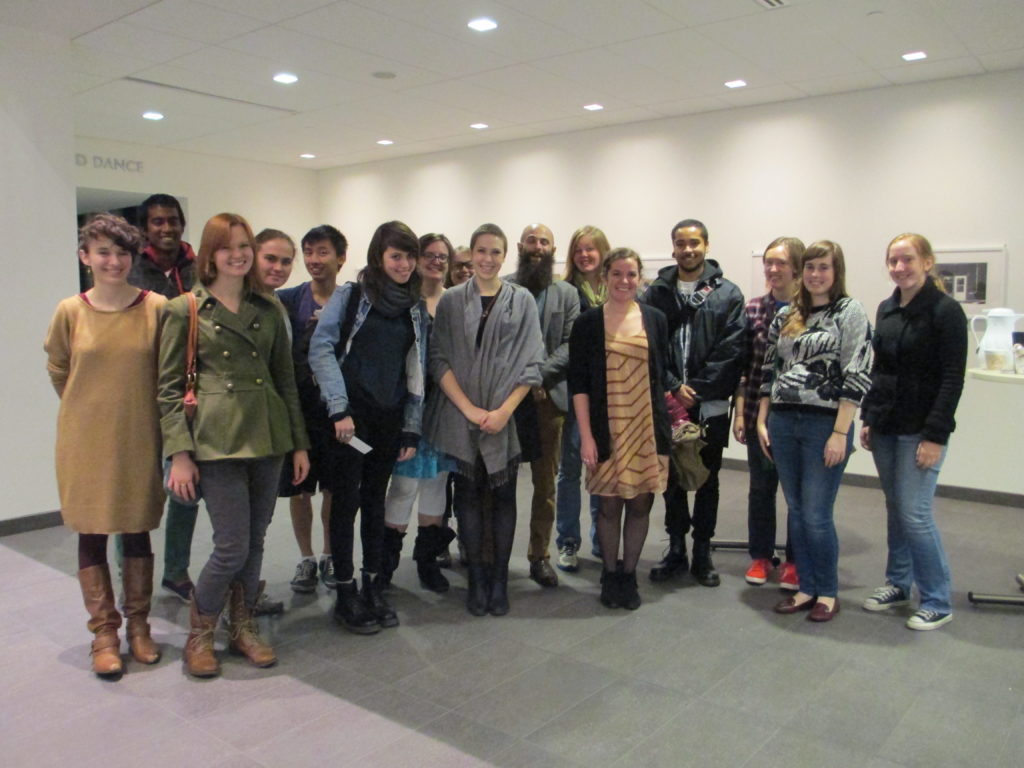
After her original show I/Macalester closed, Alana Horton (’14) noted: “We served 165 cups of tea, went through 20lbs of ice, walked back and forth to Wallace 36 times, told 48 stories, packed and unpacked suitcases 72 times, made 198 costume changes, had 8 sold-out shows and previews and moved a gigantic TV to Old Main twice.”
I/Macalester is a theatrical exploration of Macalester’s history. Horton, an English and Theatre double major, devised the play for her Directing capstone. While most seniors choose a published script, Horton decided to write her own. “I probably read thirty scripts,” Horton remembers, “But nothing really stood out to me.”
That changed when she encountered Charles Mee’s the (re)making project. Best known for his “collage-like” style of play-writing, Mee encourages other writers to use plays from the project’s online database freely to inform their own work. Horton built her ideas about Macalester’s history around a monologue from Mee’s play Hotel Cassiopeia, in which the speaker tells a story about the Greek poet Simonides and his teachings on “how to build palaces of memory.”
Horton’s two years of work in Macalester’s archives conducting oral interviews laid the foundation for a palace of memories built around the college itself. Sometimes, Horton recalled, after hearing the stories of Mac alumni, faculty, and staff, “I wanted to run out to the student body and yell, ‘We have history here!’”
Over the summer, Horton had worked on Bedlam Theatre’s piece The Big Lowdown, a play which led its audience around Lowertown St. Paul. This helped Horton envision I/Macalester as a piece that would be staged in multiple spaces around campus. Horton’s play took place in Wallace Hall, Old Main, and the theatre building’s furniture storage. She enjoyed the opportunity “to work in weird, cramped spaces” where theatre does not normally enter. “Without [this kind of] intimacy, these stories don’t really matter,” she said.
Each space became a container for a particular theme in Macalester history. The section of the show staged in Wallace focused on women’s experiences. Audiences were served a high tea under the strict dining etiquette that Wallace women through the decades would have followed.
In Old Main, audiences sat on the staircase beside the memorial plaque, where they heard stories of Macalester men and their encounters with war. The cast wheeled in a television set to display the CBS broadcast of the 1970 draft lottery, which students of the day would have watched together in the dormitory common rooms. Horton spoke about how her own Quaker upbringing drew her to engage the subject of war in play-writing. “I’ve never lived by a military base or had a first-hand encounter with war,” she noted. Yet many of her interviewees for the Mac archives remembered weekly candlelit vigils on Summit Avenue, draft card burnings, and white wooden crosses covering the lawns. “There was a level of fear and anticipation we don’t know [on this campus today],” Horton said. “No one in our generation has ever watched the [draft lottery] footage before.”
The final section of the play was devised by the cast members using what they found in the theatre’s furniture shop. This particular space interested Horton for the rich histories of all the objects it contained. She reflected on the process of “imagining the lives of things you can’t know” and the “liminal spaces of what could be.” Horton sees this as an important intellectual space in creative writing and history alike.
Horton hopes her audiences will bring this kind of imagination to their own lives as they construct their “palaces of memory.” She encourages us to examine antiques, read plaques, and wonder who lived in our rooms before us. She hopes that when we pass the words “In Memoriam” in the Old Main stairwell, we will remember: “This happened. And this happened here.”